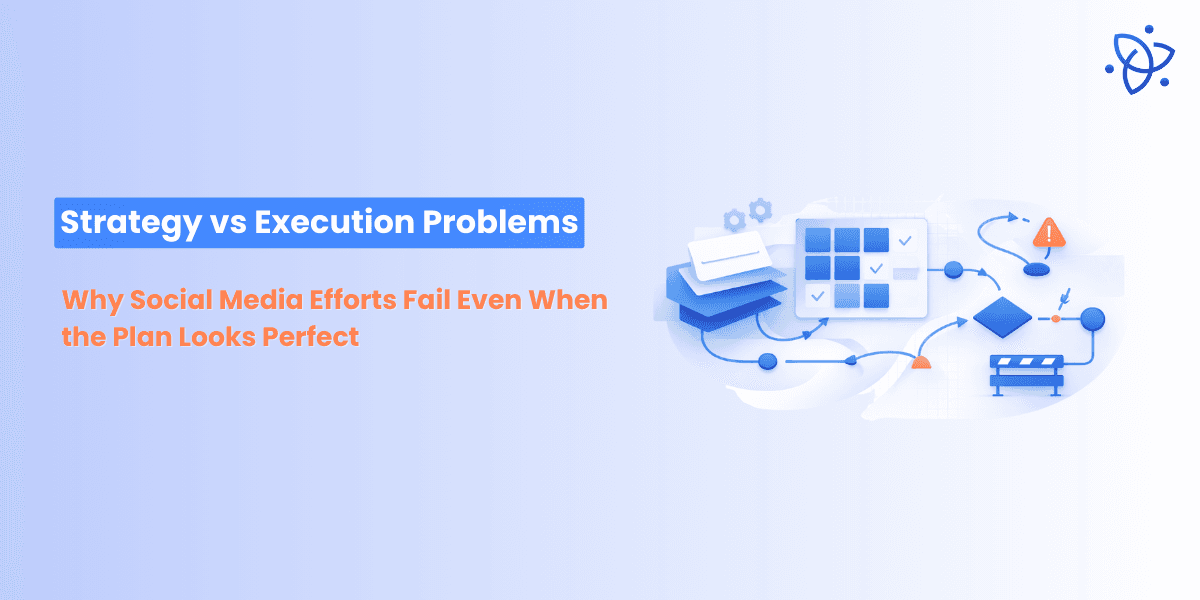
Social media teams today are more informed than ever. They understand platforms, algorithms, content formats, and analytics. Yet despite having “solid strategies,” many accounts still fail to grow, convert, or sustain momentum.
This is where the real problem lies—not in knowledge, but in the gap between strategy and execution.
In practice, most social media failures are not caused by bad ideas. They’re caused by good strategies that are poorly executed, inconsistently applied, or misaligned with real-world constraints. Understanding the difference between social media strategy vs execution is one of the most important skills a modern marketer can develop.
This article breaks down:
-
What strategy and execution actually mean in social media
-
Where execution breaks in real-world scenarios
-
Why teams misdiagnose execution issues as “strategy problems”
-
How to fix the gap with a practical, repeatable framework
This is not theory. This is how social media breaks in practice—and how experienced marketers prevent it.
Understanding Social Media Strategy vs Execution (Without Buzzwords)
Before fixing the problem, we need clarity. Most teams misuse these terms.
What Social Media Strategy Really Is
A social media strategy defines direction, not activity.
It answers questions like:
-
Who are we trying to reach—and why?
-
What role does social media play in the business?
-
What outcomes matter: awareness, leads, trust, sales, retention?
-
What platforms deserve focus—and which don’t?
-
What content themes will we own consistently?
Strategy is about choices and trade-offs. If your plan tries to do everything, it’s not a strategy.
In practice, a strong strategy creates constraints:
-
“We do not chase trends unrelated to our positioning.”
-
“We prioritize depth over frequency.”
-
“We optimize content for saves and shares, not vanity likes.”
What Social Media Execution Actually Means
Execution is the disciplined, repeatable process of turning strategy into visible action.
It includes:
-
Content production quality and consistency
-
Publishing workflows and timelines
-
Copywriting, hooks, visuals, and CTAs
-
Community engagement and responses
-
Measurement, feedback loops, and iteration
Execution is not “posting daily.” It is how well each action reflects the strategy.
Here’s the key insight experienced marketers know:
A weak strategy can sometimes perform well with strong execution.
A strong strategy always fails with weak execution.
Why the Strategy vs Execution Gap Is So Common Today
Most social media teams believe they have a strategy. In reality, they have a content calendar.
This disconnect creates a dangerous situation:
-
Strategy is documented once (often in a deck)
-
Execution happens daily, under pressure, with shortcuts
-
No system ensures alignment between the two
Over time, execution drifts—while leadership still believes the strategy is being followed.
This is why diagnosing social media strategy vs execution problems requires looking beyond surface metrics.
The Core Diagnostic Question Most Teams Never Ask
When performance drops, teams usually ask:
-
“Is our strategy wrong?”
-
“Is the algorithm changing?”
-
“Do we need more content?”
The better diagnostic question is:
“Is our execution still aligned with our original strategic intent?”
In practice, most teams fail because:
-
Execution slowly optimizes for speed, not quality
-
Content decisions are made reactively
-
Strategy becomes a reference document, not an operating system
This leads directly to social media execution problems that look like strategy failures.
A Practical Framework to Diagnose Strategy vs Execution Problems
Use this step-by-step framework to identify where things are breaking.
Step 1: Validate the Strategy Before Blaming Execution
Before fixing execution, confirm the strategy is still sound.
Ask:
-
Is our target audience clearly defined—or has it expanded unintentionally?
-
Are our goals measurable and realistic for social media?
-
Does our strategy reflect current business priorities?
If the answers are unclear, execution cannot succeed.
In practice:
Many brands still execute a “growth-focused” strategy long after the business needs leads or retention. Execution looks busy, but results feel meaningless.
Step 2: Check for Execution Drift
Execution drift happens when day-to-day decisions slowly move away from strategy.
Common signs:
-
Content topics change based on trends, not positioning
-
Hooks are optimized for clicks, not relevance
-
Visuals prioritize speed over clarity
-
Captions lose depth over time
This is one of the most common social media execution problems.
Example:
A B2B brand starts posting generic motivational quotes because they “perform well,” even though the strategy was built around thought leadership.
Execution is working—but against the strategy.
Step 3: Identify Bottlenecks in the Execution System
Execution is a system, not a person.
Break it down:
-
Ideation → Production → Review → Publishing → Engagement → Analysis
Where does it slow down or degrade?
Common bottlenecks:
-
Too many approvals (kills momentum)
-
No clear content owner (kills accountability)
-
Poor briefs (kills quality)
-
No feedback loop (kills learning)
Most social media marketing mistakes happen here—not in strategy.
Step 4: Evaluate Skill vs Capacity Gaps
Execution fails for two reasons:
-
The team lacks skill
-
The team lacks capacity
They require different fixes.
Skill gaps look like:
-
Weak hooks
-
Generic copy
-
Poor storytelling
-
Inconsistent tone
Capacity gaps look like:
-
Missed deadlines
-
Rushed visuals
-
Reused ideas
-
Burnout-driven posting
In practice, teams misdiagnose capacity issues as skill problems and keep “improving strategy” instead of fixing resources.
Real-World Scenarios: How Strategy vs Execution Problems Show Up
Scenario 1: “Our Strategy Is Solid, But Engagement Is Dropping”
What’s really happening:
-
Execution has become repetitive
-
Content formats haven’t evolved
-
Hooks no longer stop the scroll
The strategy may still be valid—but execution has stagnated.
Fix:
Audit the last 30 posts. If they look interchangeable, execution—not strategy—is the issue.
Scenario 2: “We Post Consistently, But Nothing Converts”
This is a classic social media strategy vs execution confusion.
In practice:
-
Strategy defines conversion paths
-
Execution must guide users intentionally
Common execution failures:
-
No contextual CTAs
-
No narrative sequencing
-
No trust-building content
Posting consistently without intent is an execution flaw, not a strategy flaw.
Scenario 3: “Different Team Members Execute the Same Strategy Differently”
This reveals a missing execution standard.
Symptoms:
-
Inconsistent tone
-
Varying content depth
-
Uneven quality across platforms
Strategy without execution guidelines leads to fragmentation.
Experienced marketers know:
Execution requires principles, templates, and examples—not just goals.
The Most Common Social Media Execution Problems (And Their Root Causes)
1. Optimizing for Output Instead of Impact
Root cause:
-
Pressure to post frequently
-
Misunderstanding platform metrics
Result:
-
High volume, low relevance
-
Burnout without growth
Execution mistake—not strategy.
2. Confusing Trends With Strategy
Root cause:
-
Fear of missing out
-
Reactive decision-making
Result:
-
Inconsistent positioning
-
Audience confusion
Trends should be filtered through strategy—not replace it.
3. No Feedback Loop Between Data and Content
Root cause:
-
Analytics seen as reporting, not learning
-
No time allocated for review
Result:
-
Same mistakes repeated
-
No execution evolution
Execution without learning is just activity.
4. Over-Reliance on Tools Without Process
Root cause:
-
Belief that tools replace thinking
-
No defined workflows
Result:
-
Inconsistent results
-
Fragmented execution
Tools amplify execution—but they don’t fix broken systems.
Best Practices to Close the Strategy–Execution Gap
1. Translate Strategy Into Execution Rules
Turn strategy into:
-
Content do’s and don’ts
-
Platform-specific guidelines
-
Clear success metrics per content type
Execution needs constraints to stay aligned.
2. Build Execution Checklists, Not Just Calendars
Every post should pass a checklist:
-
Does this serve the target audience?
-
Does this reinforce positioning?
-
Is the hook intentional?
-
Is the CTA clear?
This prevents silent execution drift.
3. Separate Creative Time From Publishing Time
Most execution problems come from multitasking.
Best practice:
-
Batch ideation
-
Batch production
-
Batch publishing
-
Separate analysis sessions
This improves quality without increasing workload.
4. Review Execution Weekly, Not Just Monthly
In practice, monthly reviews are too late.
Weekly execution reviews should focus on:
-
What worked and why
-
What failed and why
-
What to stop doing
This connects closely with social media strategy frameworks and planning processes.
5. Assign Ownership, Not Just Responsibility
Execution fails when “everyone” is responsible.
Every piece of content needs:
-
One owner
-
One decision-maker
-
One reviewer
Clarity beats collaboration in execution.
How Experienced Marketers Think About Strategy vs Execution
Experienced marketers don’t argue whether strategy or execution matters more.
They understand:
-
Strategy sets direction
-
Execution creates reality
-
Alignment sustains results
Most teams fail because they keep rewriting strategy instead of fixing execution systems.
This is why many social media marketing mistakes repeat across industries and platforms.
The Hidden Cost of Ignoring Execution Problems
When execution breaks:
-
Teams lose confidence
-
Stakeholders lose trust
-
Social media becomes “unreliable”
Eventually, leadership concludes:
“Social media doesn’t work for us.”
In reality, execution didn’t.
Summary: Key Takeaways on Social Media Strategy vs Execution
-
The real issue is rarely strategy alone—it’s misaligned execution
-
Execution drift is gradual and often invisible
-
Most social media execution problems come from systems, not people
-
Fixing execution requires structure, clarity, and feedback loops
-
Strong execution can rescue average strategies
-
Weak execution will destroy even the best strategies
Understanding social media strategy vs execution is not optional anymore—it’s foundational.
Many marketers now prefer automated strategy builders instead of doing everything manually, especially to reduce execution inconsistency and planning fatigue.
If your social media feels busy but ineffective, don’t rewrite the strategy yet.
First, diagnose how it’s being executed in the real world.