The post was on-brand. The copy was sharp. The visual was exactly what the brief asked for.
Then the client saw it live - and it was the wrong version. An earlier draft, missing the updated promo details, had gone out by mistake. No final sign-off. No version control. Just a preventable error that took three hours to fix and two weeks to recover from in the client relationship.
Approval failures rarely come from bad content. They come from unclear processes - no defined stages, no documented sign-offs, no single source of truth for what's been approved and what hasn't.
A structured social media approval process eliminates that category of problem entirely. This guide covers how to build one, what it should include, and how to communicate it clearly to clients from day one.
What Is a Social Media Approval Process?
A social media approval process is a structured workflow that takes content from creation through internal review, client feedback, and final sign-off before it goes live. It defines who reviews what, in what order, by when — and ensures nothing gets published without explicit approval. For teams looking to streamline digital approvals, an eSignature API for dev can help automate the signing and approval process within existing workflows.
It is not:
-
A content calendar
-
An email chain with "looks good!" somewhere in it
-
A verbal confirmation on a call
In practice, a working approval process answers five questions for every piece of content:
-
Who created this and is it ready for review?
-
Who reviews it internally before the client sees it?
-
How does the client give feedback - and by when?
-
How many revision rounds are permitted?
-
What constitutes final approval, and where is it documented?
Without clear answers to all five, the process runs on assumptions - and assumptions are where approvals break down.
Why the Social Media Approval Process Matters
One unapproved post going live at the wrong time, with the wrong copy, or missing a legal disclaimer can cause significant damage - from client trust erosion to PR issues that take months to recover from. The approval process exists to make that outcome structurally impossible, not just unlikely.
Beyond damage prevention, a clear approval workflow does four things consistently:
Keeps tone, visuals, and messaging aligned. When multiple team members or agencies contribute to a client's content, inconsistency creeps in. An approval workflow catches drift before it goes public.
Makes stakeholder alignment explicit. Instead of assuming a client is happy with the direction, the approval process creates documented checkpoints where alignment is confirmed in writing.
Reduces back-and-forth. Counterintuitively, a more structured process means fewer emails, not more. When everyone knows the stages and the deadlines, there's no chasing for feedback or clarifying who needs to approve what.
Creates an audit trail. For clients in regulated industries, or in any situation where a post is later questioned, documented approvals protect both the agency and the client.
Without a process, teams face delayed publishing schedules, repeated revision cycles, and - worst of all - public mistakes that were entirely preventable.
Key Stages of the Social Media Approval Workflow
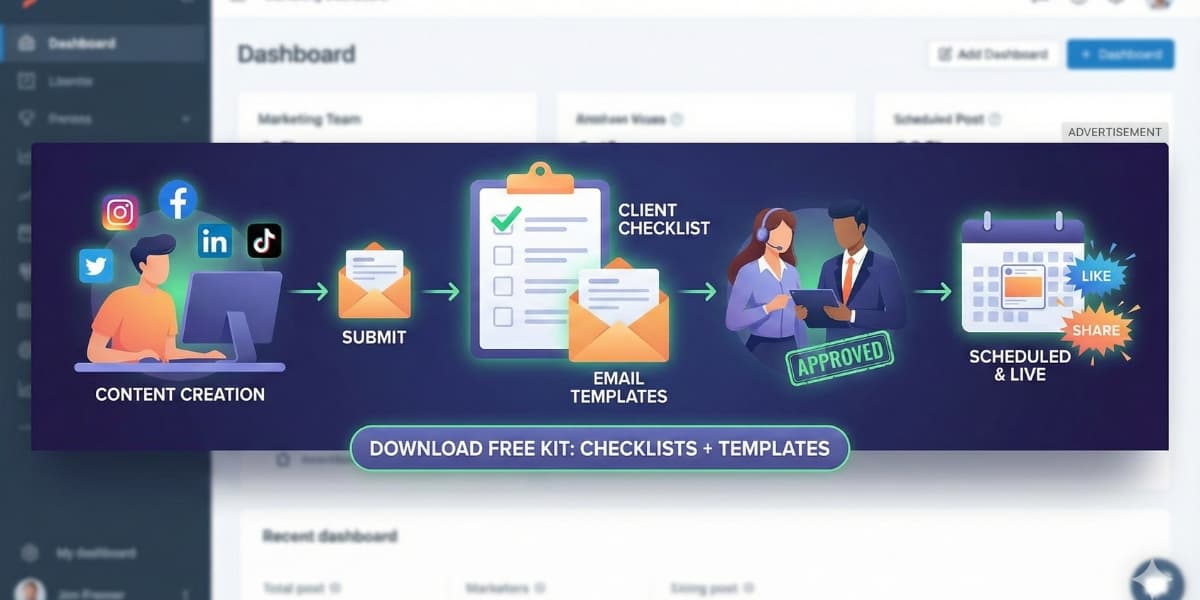
A well-built approval workflow has six distinct stages. Each one has a clear output and a clear owner.
|
Stage |
What Happens |
Who Owns It |
|
Ideation |
Content ideas generated and aligned to campaign goals |
Strategist / Account Manager |
|
Drafting |
Posts, captions, and visuals created |
Content Creator / Designer |
|
Internal Review |
Team checks tone, accuracy, brand fit, and platform suitability |
Senior Editor / Account Lead |
|
Client Review |
Client gives feedback, requests edits, or approves |
Client / Client-Side Stakeholder |
|
Final Approval |
Written sign-off confirmed before scheduling |
Client + Account Manager |
|
Publishing |
Content scheduled and published |
Social Media Manager |
The most common failure point is between Internal Review and Client Review - content gets sent to clients before internal quality checks are complete, which results in the agency looking unprepared and the client doing your editorial work for you.
Run the internal review properly every time. The client review should catch strategic misalignments, not typos.
How to Build a Social Media Approval Workflow
Building the workflow is less about choosing tools and more about making decisions. The tools come after the decisions are made.
Step 1: Define Roles and Responsibilities
Before anything else, document who does what. Ambiguity here is the root cause of most approval delays.
At minimum, every approval workflow needs:
-
A content creator - produces the initial draft
-
An internal reviewer - checks quality before the client sees it
-
A client contact - the designated person who can approve on the client's side
-
An account manager - manages the process, chases feedback, and keeps timelines on track
If a client insists that five stakeholders all need to approve content, that needs to be negotiated upfront - not discovered on the first deadline day.
Step 2: Standardise Your Communication Channel
Email threads are where approval processes go to die. By the third round of revisions, nobody can find the original brief, the feedback is scattered across four different messages, and the "approved" version is unclear.
Choose one tool and make it mandatory. Project management platforms like Notion, Asana, or ClickUp give every piece of content its own thread. Purpose-built content approval tools like Planable allow inline commenting directly on posts. Whatever you choose, the rule is simple: all feedback and approvals happen in the designated tool, not over email or on calls.
Step 3: Set Revision Limits Upfront
Unlimited revisions aren't a service offering - they're a boundary problem. Define the number of revision rounds included in the engagement before work begins, and document it in the contract or onboarding materials.
A practical standard: two rounds of revisions per content batch. After that, additional rounds are billed at an agreed rate. Most clients never reach round two when they know the limit exists from the start.
Step 4: Implement Version Control
Every draft should be versioned clearly - V1, V2, V3 - with the current approved version always clearly labelled. When clients or team members refer to "the latest version," there should be no ambiguity about what that means.
Cloud-based tools with version history (Google Docs, Notion, Planable) handle this automatically. If you're using static files, name them clearly and archive previous versions in a dedicated folder.
Step 5: Automate Approval Notifications
Every time content moves from one stage to the next, the relevant person should be notified automatically - not by a manual email or a Slack message that gets buried. Tools like Asana, Trello, and Buffer all support automated status notifications. Set them up at the start of each client relationship.
Step 6: Archive All Approvals
Every written sign-off should be stored somewhere retrievable. This protects both parties. If a client later questions why a post went live, the documented approval ends that conversation immediately.
The Social Media Content Approval Checklist
Run every piece of content through this checklist before it leaves internal review. Nothing should go to the client with obvious gaps.
Pre-Approval: Strategy Alignment
-
[ ] Content aligns with the current social media strategy and campaign goals
-
[ ] Campaign KPIs are defined and this content supports them
-
[ ] Brand guidelines reviewed - tone, visual style, messaging hierarchy
-
[ ] Legal or compliance requirements checked (disclaimers, claims, regulated content)
-
[ ] Platform-specific formatting applied - caption length, image dimensions, hashtag strategy
Internal Content Review
-
[ ] Messaging accurate and factually correct
-
[ ] Copy reviewed for spelling, grammar, and tone
-
[ ] Visuals reviewed by design - on-brand, correct dimensions, legible at mobile size
-
[ ] CTA present, clear, and aligned with the campaign goal
-
[ ] All links tested and tracking parameters (UTM) applied
-
[ ] No placeholder text, wrong dates, or draft-stage notes left in
Client Review Stage
-
[ ] Content sent to the correct client contact - not broadcast to multiple stakeholders without a single decision-maker named
-
[ ] Clear feedback deadline communicated (specific date and time, not "by end of week")
-
[ ] Feedback format specified - consolidated, in writing, in the agreed tool
-
[ ] Number of revision rounds remaining noted
Final Approval Stage
-
[ ] Written sign-off received and stored
-
[ ] All requested revisions incorporated and confirmed
-
[ ] Final version uploaded to scheduling tool
-
[ ] Post backed up and archived in client folder
-
[ ] Publishing date and time confirmed against the content calendar
Email Templates for Client Approval
These three templates cover the most common scenarios. Adapt the tone to match the client relationship, but keep the structure - it's what makes the process repeatable.
Template 1 - Initial Draft for Review
Subject: [Client Name] - Social Media Content for Review: [Month / Campaign Name]
Hi [Client Name],
Please find attached your draft social media content for [Month / Campaign Name].
We'd appreciate your feedback or approval by [specific date]. To keep the production timeline on track, we'd ask that all feedback comes through as a single consolidated response - this helps us turn revisions around quickly without missing anything.
If everything looks good as is, a reply confirming approval is all we need to proceed with scheduling.
Please let us know if you have any questions about the content direction before reviewing.
Best, [Your Name] [Agency / Your Name]
Template 2 - Revised Draft Following Feedback
Subject: [Client Name] - Updated Content Following Your Feedback
Hi [Client Name],
Thanks for your input on the previous draft. We've worked through your feedback and the updated content is attached.
Key changes made:
-
[Specific change 1]
-
[Specific change 2]
-
[Specific change 3]
Please review and let us know if this version is ready for final approval, or if there are any remaining points to address. This is revision round [X of X] included in your current plan.
Best regards, [Your Name] [Agency / Your Name]
Template 3 - Final Sign-Off Request
Subject: [Client Name] - Final Approval Needed: [Month / Campaign Name]
Hi [Client Name],
We're ready to schedule your content for [Month / Campaign Name] and just need your final confirmation before we proceed.
Please reply with "Approved" - or let us know by [specific date] if there's anything you'd like to adjust before we schedule.
Once confirmed, we'll proceed with publishing as per the agreed calendar.
Thank you for a smooth process on this one.
Warm regards, [Your Name] [Agency / Your Name]
How to Build the Approval Process Into a Monthly Content Calendar
The approval workflow and the content calendar should be built together, not managed separately. When approvals are an afterthought, they compress production time and create deadline pressure that leads to errors.
A practical monthly structure:
|
Week |
Content Tasks |
Approval Stage |
|
Week 1 |
Briefing, content planning, ideation |
Client signs off on content direction |
|
Week 2 |
Drafting posts, captions, and visuals |
Internal review complete |
|
Week 3 |
Client review period |
Client feedback received and incorporated |
|
Week 4 |
Final revisions, scheduling, and archiving |
Written sign-off received; content queued |
The rule that prevents most delays: client deadlines go in the calendar before production starts. If the client needs to approve by Thursday of Week 3, that Thursday appears on the calendar on day one - not as a surprise when the deadline arrives.
Real-World Scenarios: Approval Workflows in Practice
Scenario 1: Freelancer Managing Multiple Clients
The challenge for freelancers isn't creating the workflow - it's maintaining it consistently across clients with different expectations, different tools, and different levels of involvement in the content process.
The most practical approach: one standardised approval structure applied to every client, with the client's specific preferences noted in their onboarding document. Same stages, same templates, same revision limits - the specifics vary per client, the process doesn't.
Freelancers who document their process formally - even a one-page workflow overview - find that clients take it more seriously, provide feedback more efficiently, and push back less on revision limits. The documentation signals professionalism before a single piece of content is created.
UTM tracking and final archiving (the last two steps on the checklist) are also where freelancers consistently protect themselves. When a client later questions a post's performance or claims they never approved something, documentation ends the conversation.
Scenario 2: Agency Managing Multiple Client Accounts
At agency scale, the approval process isn't just a quality-control mechanism - it's a capacity planning tool. How many revision rounds are outstanding across all clients? Which accounts have approvals overdue? Which content is blocked waiting on stakeholder sign-off?
Without a centralised system, these questions get answered by chasing Slack messages and checking email chains. With a project management tool set up correctly, they're answered in a dashboard in thirty seconds.
The biggest efficiency gain for agencies is usually at the internal review stage. When the internal review is done properly every time, client revision rounds drop significantly - because clients aren't doing the agency's editorial work for them. Setting a non-negotiable internal review checkpoint before any content reaches the client is the single change that moves most agencies from two revision rounds per client to one.
Scenario 3: In-House Team Managing Brand Accounts
In-house teams face a different problem: too many internal approvers. Brand, legal, compliance, and the marketing director all want to see content before it goes live. Without a defined approval chain, that becomes a bottleneck that makes social media publication unpredictably slow.
The fix is a single designated approver per content type - not per piece of content. Brand content gets approved by the Brand Manager. Promotional content with claims goes through legal. Standard social posts are approved by the Social Media Manager. The approval matrix is documented once, reviewed quarterly, and removes the need for a separate decision about who to send each post to.
Common Mistakes in the Approval Process
Too many approvers without a decision-maker. Five people reviewing content with equal authority produces conflicting feedback and no clear resolution path. Name one decision-maker per client or account. Everyone else can contribute feedback; only one person can block publication.
Verbal approvals. "The client said it was fine on the call" is not an approval. Written sign-off is non-negotiable - for your protection as much as theirs. If a client approves verbally, follow up with an email confirmation before scheduling.
No feedback deadline. "Please review when you get a chance" produces a response when the client has a chance - which is often after the publishing window has closed. Set specific deadlines for every review stage and include them in every communication.
Working from multiple draft versions. When a client emails feedback on V1 while the team is already working on V2, the revision cycles multiply. Version control is not a nice-to-have; it's the mechanism that keeps everyone working on the same document.
Skipping the final check before scheduling. A post approved at 9am on Monday can develop a problem by the time it's scheduled to go live on Friday - a news event makes the timing sensitive, a link breaks, a promotion ends early. Run a brief final check before every post goes live, even after sign-off.
FAQ: Social Media Approval Process
What is a social media approval process?
A social media approval process is a structured workflow for reviewing, revising, and formally signing off on content before it's published. It defines who reviews what, in what order, by what deadline - and ensures every post has explicit written approval before it goes live.
Why do agencies need a formal approval process?
Without a formal process, agencies face delayed publishing schedules, multiple revision rounds, client disputes about what was approved, and occasionally, posts going live with errors. A documented process prevents all of these by creating clear stages, responsibilities, and sign-off requirements.
How many rounds of revisions should be included in a social media approval workflow?
Two rounds is the standard for most agencies. The first round addresses major directional feedback; the second addresses fine-tuning. Beyond two rounds, the process is usually a sign of an unclear initial brief rather than a content quality issue - and additional rounds should be scoped and billed accordingly.
What tools are best for social media content approvals?
Purpose-built options include Planable (visual content collaboration with inline commenting), ContentStudio (centralised approval dashboards), and Hootsuite's content approval features. For teams already in project management tools, Notion, Asana, and ClickUp all support structured approval workflows with notifications and version tracking.
How should clients submit feedback during the approval process?
Consolidated, written, and in the designated tool - not spread across email replies, WhatsApp messages, and a separate call. Consolidation means one round of feedback from all stakeholders, not individual notes sent as each person reviews. Setting this expectation in the onboarding process prevents the most common source of approval delays.
How long should a social media approval process take?
For a standard content batch, 2–3 business days per review round is a realistic expectation. Longer timelines are usually a sign that the client's internal approval chain is unclear, or that the content isn't reaching the right decision-maker. Building the approval deadline into the content calendar from the start prevents timeline compression.
What counts as a formal approval?
Written confirmation from the designated client contact - in the project management tool, over email, or via a formal sign-off button in a content approval platform. Verbal approvals on calls, vague emoji reactions, and "this looks good" messages without a clear context do not constitute sign-off for recordkeeping purposes.
How do you handle a client who is slow to approve content?
Set clear approval deadlines in the contract and content calendar, automate reminder notifications through your project management tool, and include a clause covering what happens when feedback is delayed - for example, that late approvals push the publishing date out proportionally. Most approval delays stem from unclear expectations, not unwilling clients.
Should the approval process differ for organic vs paid social content?
Yes. Paid social content typically requires an additional layer of review - particularly for claims, targeting parameters, and compliance - before it goes live. The approval workflow for paid content should include a legal or compliance checkpoint that organic content doesn't necessarily require.
How do you manage approvals when multiple client stakeholders are involved?
Nominate a single internal client contact who consolidates all stakeholder feedback before it comes to the agency. This is non-negotiable for efficient workflow management. If a client insists on multiple approvers with equal authority, define a clear escalation process for when their feedback conflicts - and document it before the first piece of content is reviewed.
Final Thoughts: The Process Is the Product
Creative quality gets clients interested. Process quality keeps them.
An agency or freelancer that produces good content with a chaotic approval workflow will lose clients to one that produces equally good content with a clear, documented process. The approval workflow is not administrative overhead - it's part of what you're selling.
When the process runs smoothly, clients trust you more, revisions happen faster, and content goes live on time. That outcome is entirely within your control.
Want to discuss approval workflows, client communication strategies, and real social media processes with marketers who've built these systems in practice?
Key Takeaways
-
A social media approval process defines who reviews what, in what order, and by when
-
Internal review should catch quality issues before the client ever sees the content
-
Written sign-off is non-negotiable - verbal approval is not approval
-
Two revision rounds is the standard; additional rounds should be scoped upfront
-
One designated decision-maker per client prevents conflicting feedback and delays
-
All approvals should be archived - the documentation protects both parties
-
The approval workflow and content calendar should be built together, not managed separately
-
Version control is what keeps everyone working from the same document